

What's the Difference Between Divorce and Legal Separation? An Oklahoma Guide.
Picking between a legal separation and a divorce feels impossible when your marriage hits a breaking point. Both paths promise relief from a painful situation, but they lead to dramatically different outcomes for your finances, your children, and your ability to move forward.
Our Oklahoma legal separation lawyers and divorce attorneys help families make this decision with clarity, not confusion. This guide breaks down the legal separation vs divorce debate so you can choose the option that actually serves your interests.
What Is Legal Separation
Legal separation creates court-ordered living arrangements while keeping your marriage legally intact. Oklahoma family law allows couples to formally separate their lives without dissolving their marital bond through proceedings similar to divorce, but with different outcomes.
How Legal Separation Works
When you file for legal separation under 43 O.S. § 107, the court system establishes binding agreements covering child custody arrangements, child support obligations, spousal support payments, and property division. This separation agreement serves as a court-approved legal contract.
Simply living apart doesn't create a legally separate status; you need a formal court order addressing debt division, health insurance coverage, tax filing options, and custody arrangements during the separation period.
What Happens After Legal Separation
Legal separation creates a middle ground where you remain legally married while living under court-ordered terms. This status continues until you either reconcile or convert the separation to divorce.
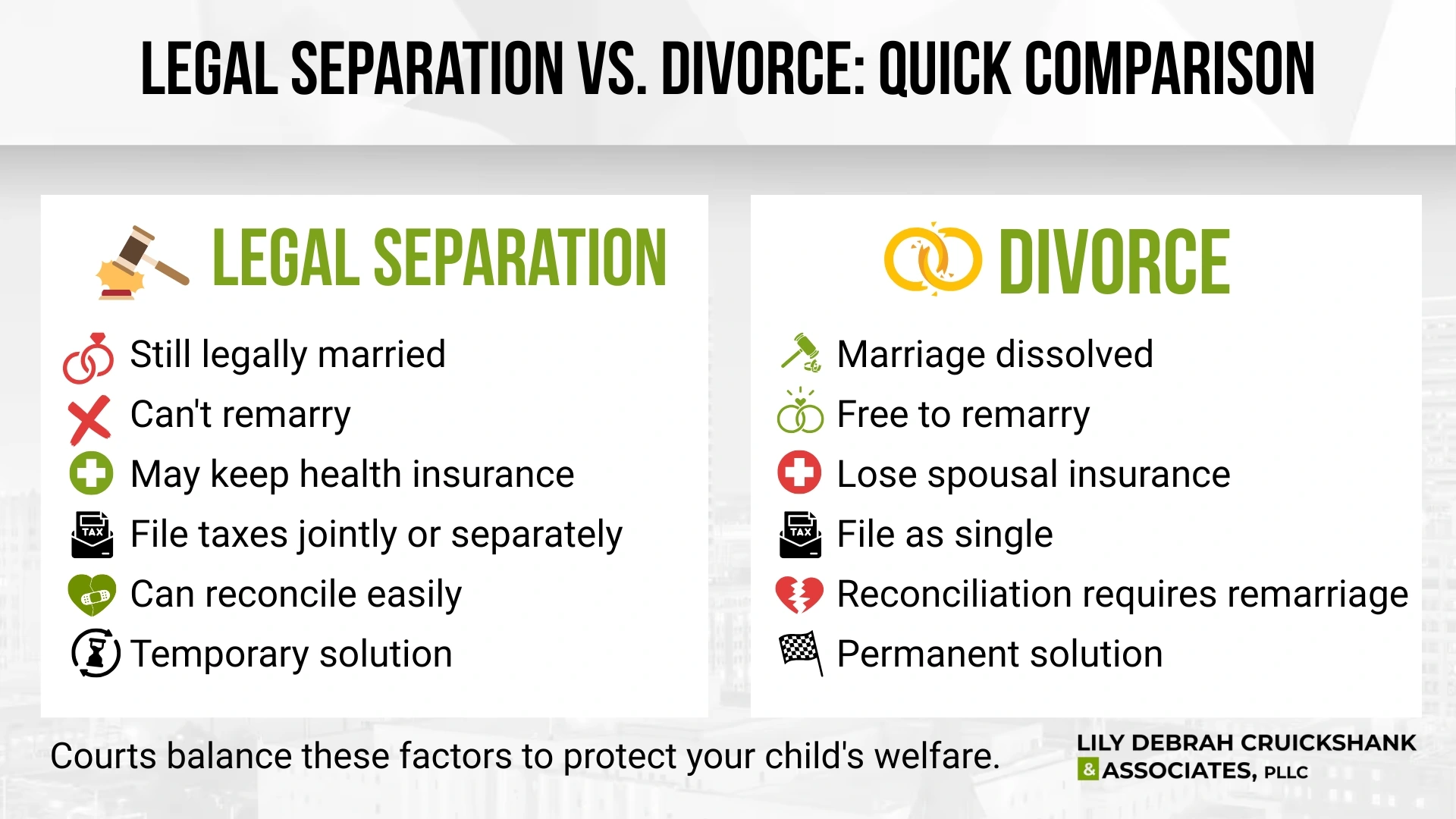
- You stay legally married and cannot remarry while the separation remains in effect.
- All agreements regarding custody, support, and property division remain in effect unless modified by the court.
- Certain benefits, like health insurance coverage and joint tax filing options, remain available.
- You can resume your marriage without legal proceedings by living together again.
- Most couples eventually file for divorce, making separation a temporary phase.
What Is Divorce

Divorce proceedings terminate your marriage completely through a court process governed by 43 O.S. § 101 et seq. Unlike legal separation, divorce severs all legal ties between spouses and allows both parties to remarry.
How the Divorce Process Works
The divorce process begins when one spouse files a petition with the court, which then establishes temporary orders for custody, support, and property arrangements. Both spouses provide complete financial disclosure before reaching agreements through negotiation, culminating in a final divorce decree that permanently ends the marriage.
Oklahoma law requires a 90-day waiting period under 43 O.S. § 107.1, which extends to 180 days for married couples with minor children. Learn more about Oklahoma divorce timelines in our detailed guide.
What Happens After Divorce
Divorce changes your legal status permanently across multiple dimensions. Your marital status becomes single for all legal purposes, while health insurance coverage through your spouse typically ends immediately.
- You become legally single and can enter new marriages without restrictions.
- You file taxes as a single or head of household instead of jointly.
- Each spouse assumes individual responsibility for future debts.
- Your former spouse no longer has the authority to make healthcare decisions on your behalf.
- All marital property gets permanently divided according to the divorce decree.
Legal Separation vs. Divorce: Key Differences That Matter
The main difference between legal separation and divorce centers on whether the marriage continues to exist legally. This distinction creates practical consequences across multiple areas of your life, from your ability to remarry to your financial responsibilities.
Marital Status and Remarriage Rights
Legal separation leaves you legally married despite living separately, which prevents remarriage while the separation remains in effect. Under Oklahoma law, divorce completely dissolves the marriage bond, restoring your single status and removing all restrictions on entering new marriages.
Financial Responsibilities and Benefits
Legal separation allows spouses to maintain military retirement benefits, health insurance under family plans, and tax benefits from joint filing, with debts incurred before separation remaining joint unless otherwise specified. However, retirement accounts typically cannot be divided during legal separation, as plan administrators normally require an actual divorce decree to divide these accounts.
Divorce makes property division permanent, while each spouse starts fresh financially, with new debts belonging solely to the spouse who creates them. Retirement accounts can be divided according to the divorce decree through Qualified Domestic Relations Orders (QDROs) once the divorce is finalized.
Insurance and Healthcare Coverage
Health insurance coverage represents a critical difference between legal separation and divorce in Oklahoma. Legal separation often allows one spouse to remain on the other spouse's employer-sponsored health plan, particularly valuable when pre-existing conditions make individual coverage expensive or unavailable. Divorce typically terminates this coverage immediately, leaving the uninsured spouse to seek alternative healthcare through private insurance markets or government programs.
Pros and Cons of Legal Separation vs. Divorce
Understanding the differences between divorce and legal separation requires examining the advantages and drawbacks of each. These considerations help couples decide which path aligns with their personal needs and circumstances.
Advantages of Legal Separation
✅ Time for decision-making: Separation offers breathing room to evaluate whether the relationship can recover without the finality of divorce.
✅ Religious considerations: Some religions accept separation while prohibiting divorce, respecting these beliefs while providing legal protection.
✅ Health insurance preservation: Maintaining coverage proves crucial when one spouse depends on the other's employer-sponsored plan.
✅ Financial benefits protection: Military spouses and federal employees can preserve certain retirement benefits and Social Security eligibility as they approach the 10-year threshold, though retirement accounts themselves typically cannot be divided until divorce is finalized.
Disadvantages of Legal Separation
⚠️ Emotional uncertainty: Remaining legally married while living apart creates awkward situations and prevents full closure.
⚠️ Tax complexity: Filing as "married filing separately" often results in higher tax bills than other filing statuses.
⚠️ Two legal processes: Most separated couples eventually divorce anyway, meaning double legal costs and court proceedings.
⚠️ Continued legal ties: The other spouse retains certain legal rights despite physical separation, complicating new relationships.
⚠️ Limited retirement account division: Plan administrators typically require a divorce decree to divide retirement accounts, meaning you cannot fully separate these assets during legal separation.
Advantages of Divorce
✅ Complete freedom: Divorce dissolves all marital ties, allowing both parties to build entirely new lives without spousal considerations.
✅ Financial independence: Each person controls their own financial destiny after property division occurs.
✅ Emotional closure: The permanent solution helps both spouses move forward psychologically with clear boundaries.
✅ Simplified taxes: Filing as single or head of household becomes straightforward without coordinating with an estranged spouse.
✅ Full retirement account division: Divorce allows for complete division of retirement accounts through proper legal mechanisms like QDROs.
Disadvantages of Divorce
⚠️ Permanent decision: Unlike separation, divorce cannot be reversed; reconciliation requires remarriage from scratch.
⚠️ Loss of benefits: Health insurance, military benefits, and other marital perks typically end immediately.
⚠️ Emotionally taxing process: Divorce proceedings drain emotional energy, particularly for contested cases involving custody disputes.
What Makes Sense for Your Situation

Before weighing the options below, take a moment to consider what you need right now — not just legally, but practically and emotionally. The right choice depends on where your marriage stands and how each option affects your finances, family, and future plans.
Choose Legal Separation If:
- Religious beliefs prohibit divorce: Your faith accepts separation but considers divorce unacceptable.
- Health insurance concerns are urgent: Serious health conditions require continued coverage that divorce would eliminate.
- Reconciliation remains possible: Both spouses need space but haven't abandoned hope for the marriage.
- Financial benefits must continue: Military pensions or Social Security eligibility protections are important, though note that retirement accounts cannot typically be divided until divorce.
Choose Divorce If:
- The marriage is definitely over: Both spouses know reconciliation won't happen, making separation merely a delay.
- You want to remarry: New relationships can't progress to marriage while you remain legally married.
- Financial independence matters most: The value of completely separating finances, including full division of retirement accounts, outweighs any benefits lost.
- Emotional closure is crucial: The ambiguity of separation creates stress that prevents moving forward.
Choosing between legal separation and divorce requires evaluating your custody needs, support obligations, and property interests. Our expert Oklahoma custody lawyers help families assess these factors based on their specific circumstances, including whether relocation plans or holiday schedules affect the decision.
Your Next Step: Making the Right Choice
Legal separation and divorce both resolve key issues through court orders, but separation maintains your marriage bond while divorce dissolves it permanently. For couples who need time apart but still benefit financially from staying married, legal separation offers breathing room. For those ready to move forward completely, divorce provides the necessary finality.
Our Oklahoma City family law firm helps families throughout Oklahoma County make informed decisions about separation vs. divorce. Contact our team to discuss which path best serves your needs.
Our attorneys help Oklahoma families choose between legal separation and divorce. We serve Oklahoma City and the surrounding counties.
Court orders impact your finances and custody rights for years. Our Oklahoma City family law firm provides personalized guidance on separation vs. divorce.
Recent Posts
.avif)

Our Reach: Serving Oklahoma City and Beyond
We proudly serve the Oklahoma City community from our downtown office.Our experienced legal team extends its reach to surrounding areas, providing comprehensive family law services to families throughout the region.
Find Clarity and Direction for Your Family's Legal Matters!
Are you facing a family law challenge? Our experienced attorneys provide strategic legal representation, protecting your rights and ensuring the best possible outcome. Schedule a consultation to discuss your situation and develop a plan.
- Address722 N Broadway Ave
Suite 402
Oklahoma City, OK 73102 - Phone(405) 606-3062
- Fax(405) 606-3065
- OKLAHOMA OFFICE
- Review Us