

Can a Custodial Parent Relocate? Oklahoma Notice Requirements and Court Approval.
Relocating for a new job, family support, or a fresh start brings promise for your future. When you share custody of a child, that move involves legal requirements you need to address before deciding.
Oklahoma law balances your right to relocate with protecting the other parent's relationship with your child. Our Oklahoma City parental relocation attorneys provide guidance on notice requirements, court procedures, and custody modifications that accompany relocation.
Legal Requirements Before Moving with Your Child

Family law protects both parents' rights when one parent plans to move. Whether a custodial parent can move out of state or relocate within Oklahoma, you cannot move without following proper legal requirements, even with primary physical custody.
60-Day Written Notice Rule
Oklahoma law requires the custodial parent to provide written notice at least 60 days before any substantial relocation, as outlined in Oklahoma Statute Title 43 § 112.2. This relocation notice must be delivered to the non-custodial parent by certified mail at their mailing address. The notification should detail your new residence, the move date, the reasons for relocating, and the proposed modifications to visitation arrangements. Missing this deadline damages your case if the non-custodial parent objects.
Important note: Courts view failure to provide proper notice as a serious violation that may influence custody decisions against the relocating parent.
What Counts as Relocation
Not every move triggers these requirements. Understanding when a custodial parent can move out of city boundaries versus out-of-state matters:
- Duration factor: Temporary relocations lasting less than 60 days may not require the same formal process.
- Distance threshold: Moves exceeding 75 miles from the principal residence typically require written notice and potential court approval.
- Out-of-state moves: Any intended move across state lines requires full notification and court approval.
- Impact on visitation: Moves that significantly affect where the child spends time may need court review.
Required Information in Your Notice
Your relocation notice must include the complete physical address of the new location, your legitimate reasons for the move (employment opportunities, family support, educational opportunities, or housing), and proposed revised custody and visitation arrangements that maintain the child's relationship with the non-relocating parent, including holiday plans and summer visitation schedules.
How Courts Determine Relocation Approval
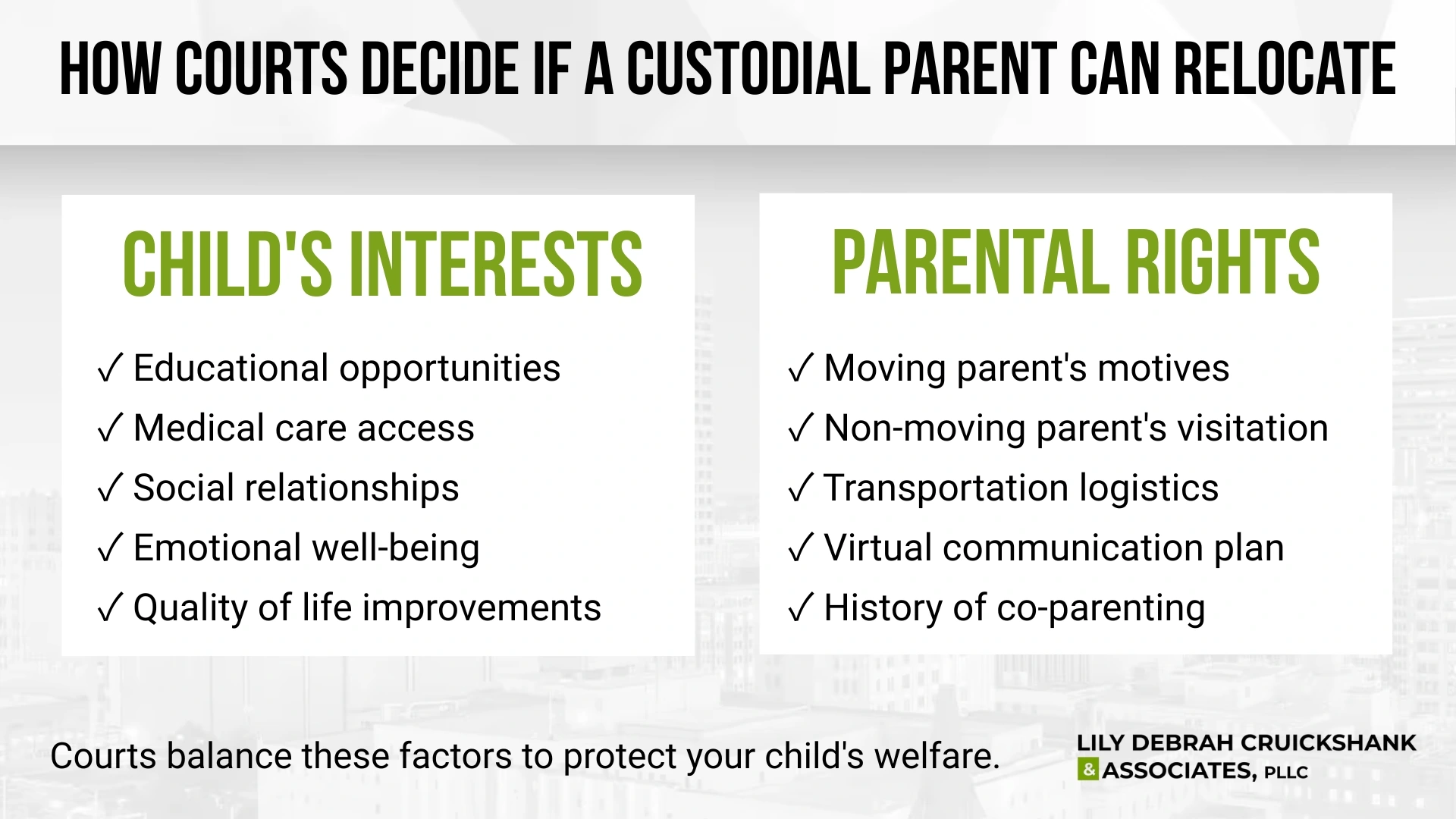
The judge's primary concern centers on the child's best interests and how the proposed relocation affects the child's life. Oklahoma courts apply specific criteria when reviewing whether the custodial parent can move out of state.
The Child's Best Interest Standard
Courts examine multiple factors to determine whether a custodial parent's relocation serves the child's best interests. They look at educational opportunities and how schools at the new location compare to current options. The child's relationships with friends, extended family, and community connections at both locations matter significantly, as does access to medical care and how the change might affect emotional adjustment.
Quality-of-life improvements play a role in the court's decision. Better housing, safer neighborhoods, or proximity to family support can strengthen your case. The court will also consider the child's preference if they are old enough to express a reasoned opinion, though this is just one factor among many.
Evaluating the Moving Parent's Motives
Judges scrutinize why you want to relocate. The Oklahoma Bar Association notes that legitimate reasons for custodial parent relocation include:
- Career advancement: A significantly better job or required transfer.
- Family support: Moving closer to relatives who can provide childcare or assistance.
- Educational pursuits: Enrollment in a degree program or training opportunity.
- Housing affordability: Lower cost of living that provides better financial stability.
Relocation requests face skepticism when the primary motivation appears to be distancing the child from the other parent rather than pursuing legitimate opportunities.
Maintaining the Non-Relocating Parent's Relationship

The court assesses how you plan to facilitate ongoing contact. Judges look favorably on parents who:
- Propose generous visitation: Extended holiday visitation, substantial summer parenting time, and flexible scheduling.
- Offer virtual communication: Regular video calls and phone access.
- Share transportation costs: Willingness to cover travel expenses or split them fairly.
- Show cooperation: A history of encouraging the parent-child relationship.
Consulting with our Oklahoma City parental relocation attorney can provide guidance on your rights and responsibilities and help you address any relocation-related custody issues.
What Happens If the Other Parent Objects
Receiving a formal written objection significantly changes the process. The objection triggers a court hearing where a judge decides whether to approve your relocation.
The 30-Day Objection Window
After receiving your relocation notice, the other parent has 30 days to file a written objection with the court. If they miss this deadline, the court may interpret their silence as consent. However, never assume silence means approval.
Preparing for a Relocation Hearing
When the non-custodial parent objects, you need to present evidence at the relocation hearing supporting why the proposed move serves the child's best interests. Gather documentation like job offer letters, school information, or evidence of family support at the new location. Working with legal counsel is extremely helpful during this emotionally charged process.
Common Reasons Courts Deny Relocation

Judges deny custodial parent relocation requests for several reasons:
- Limited legitimate purpose: Moving primarily to interfere with the other parent's relationship.
- Inadequate visitation plan: Failing to propose reasonable accommodations for the non-relocating parent.
- Negative impact on the child: Evidence showing the move would harm the child's education or well-being.
- Bad faith timing: Requesting relocation immediately after a custody order.
Modifying Custody and Visitation
Court approval for the proposed relocation rarely leaves the existing custody arrangement intact. The distance requires modifications to parenting time and visitation schedules.
Adjusting the Parenting Time Schedule
When a custodial parent relocates, courts typically restructure the visitation schedule per Oklahoma custody guidelines:
- Extended summer custody: Several weeks rather than scattered weekends.
- Holiday consolidation: Longer but less frequent visits.
- Spring break time: An entire week rather than split visits.
- Virtual contact: Scheduled phone calls and video chats.
Transportation and Cost Responsibilities
Distance creates practical challenges for exchanges. Parents may alternate driving to a midpoint location for exchanges, reducing the burden on both parties. The parent who chose to move may bear primary transportation obligations, either driving the child back for visits or covering airfare.
Transportation expenses are often split based on each parent's income. For younger children or on very long trips, the court may require one parent to accompany the child to ensure safety and comfort.
When the Court Denies Your Move

If the judge determines relocation does not serve your child's welfare, you face a difficult choice. You must abandon your relocation plans or potentially face a modification of custody in favor of the parent remaining in the current location. If your holiday or regular visitation schedule is disrupted or denied, you may need to consult with a qualified child custody attorney.
Out-of-State Custody Rights
Moving across state lines adds legal considerations beyond Oklahoma's relocation laws.
The Uniform Child Custody Jurisdiction and Enforcement Act
Oklahoma follows the UCCJEA, which determines which state's courts have jurisdiction after relocation. Your child's "home state”, where they lived for six consecutive months, initially retains jurisdiction. After establishing residence in the new state for six months, jurisdiction typically transfers.
Registering and Modifying Your Order
When you relocate, register your Oklahoma custody order with the courts in your new location. This allows the new state to enforce the order if disputes arise. Future modifications become more complicated when parents live in different states, requiring an attorney familiar with both Oklahoma law and the UCCJEA.
Get Guidance on Relocation and Custody Matters
Relocating with your child requires following Oklahoma's legal procedures. Courts aim to approve moves that benefit children while preserving meaningful relationships with both parents.
Our Oklahoma City family law attorney helps parents work through these situations with practical solutions that protect family relationships. Whether you face objections to your proposed move or need to respond to the other parent's relocation plans, we provide the legal support you need. If you need guidance on handling relocation and custody matters, reach out today to speak with our experienced attorney.
We help Oklahoma parents address relocation disputes while maintaining strong relationships with their children. Our attorneys handle court hearings, mediation, and custody modifications.
Our team handles both sides of relocation cases, whether you are moving or protecting your parenting time. We provide strategic guidance through negotiations and court proceedings.
Recent Posts
Categories


Our Reach: Serving Oklahoma City and Beyond
We proudly serve the Oklahoma City community from our downtown office.Our experienced legal team extends its reach to surrounding areas, providing comprehensive family law services to families throughout the region.
Find Clarity and Direction for Your Family's Legal Matters!
Are you facing a family law challenge? Our experienced attorneys provide strategic legal representation, protecting your rights and ensuring the best possible outcome. Schedule a consultation to discuss your situation and develop a plan.
- Address11317 S. Western Ave,
Suite 300, Oklahoma City, OK 73170 - Phone(405) 606-3062
- Fax(405) 606-3065
- OKLAHOMA OFFICE
- Review Us