

Oklahoma Military Divorce: Protecting Your Rights and Benefits
Military divorce cases involve far more legal intricacy than civilian divorces due to the intersection of federal and state laws. When either spouse serves in the military, federal regulations work alongside Oklahoma state law in ways that demand careful attention.
Working with an Oklahoma City divorce attorney specializing in military family law helps service members and their spouses protect their rights and benefits. If you're stationed at Tinker Air Force Base or anywhere else in Oklahoma, understanding how military divorce laws apply to your situation is the first step toward securing your future.
Federal Laws Governing Military Divorce Rights

Two federal statutes create the foundation for how military divorces proceed in Oklahoma. These laws work in tandem to protect service members while ensuring former spouses can access their entitled benefits. The Servicemembers Civil Relief Act and the Uniformed Services Former Spouses' Protection Act establish critical protections and division rules that Oklahoma courts must follow.
Servicemembers Civil Relief Act (SCRA)
The SCRA provides critical safeguards for active duty personnel facing legal proceedings. Courts cannot enter default judgments without confirming military status, and when military duties materially affect a service member's ability to appear, they can request a stay of proceedings for at least 90 days.
Uniformed Services Former Spouses' Protection Act (USFSPA)
The USFSPA changed how state courts handle military retirement benefits. Before USFSPA, a Supreme Court decision temporarily prevented states from treating military retirement pay as divisible marital property. USFSPA restored state courts' ability to divide disposable retired pay, permitting but not mandating division. This means that in Oklahoma, courts apply equitable distribution principles.
Dividing Military Retirement Benefits in Oklahoma
Oklahoma follows equitable distribution when dividing marital assets, meaning a fair, but not necessarily equal, division. Military pensions are among the most valuable assets in divorcing a military member, and understanding how courts divide these benefits under both federal and state law is critical.
The 10/10 Rule and Direct Payment
The Defense Finance and Accounting Service makes direct former spouse payments only when specific criteria are met:
- 10 years of marriage: The couple must have been legally married for at least 10 years.
- 10 years of creditable service: The service member must have performed at least 10 years of service during the marriage.
- Overlap requirement: Those 10 years of service must have occurred during the 10 years of marriage.
The 10/10 rule affects payment mechanics, not entitlement amounts, which Oklahoma courts determine based on equitable distribution factors.
Calculating Disposable Military Retired Pay

Not every dollar of military retired pay is divisible property. Courts use disposable retired pay, which is the member's gross retired pay minus certain deductions, such as overpayments, certain disability-related amounts, and eligible Survivor Benefit Plan (SBP) premiums. VA and DoD disability payments are excluded and can't be divided as marital property. Existing child support or alimony obligations don't change the definition of disposable retired pay, but DFAS caps the total amount that can be sent out.
Oklahoma's Approach to Property Division
Family law courts in Oklahoma examine several factors when dividing military pensions rather than applying an automatic 50/50 split. Property division attorneys guide clients through how courts weigh these considerations:
- Marriage duration: How long the couple was legally married affects the division calculation.
- Financial circumstances: Each spouse's current financial situation and future earning potential.
- Service overlap: The years of creditable service that occurred during the marriage.
- Marital contributions: What each person contributed financially and non-financially during the marriage.
- Other marital assets: Whether other property exists that could be awarded instead of dividing retirement benefits.
Courts also consider other marital assets available for distribution, sometimes awarding property to one spouse instead of dividing retirement benefits, allowing judges to craft fair outcomes based on each family's circumstances.
Healthcare Benefits: The 20/20/20 and 20/20/15 Rules
Healthcare coverage through TRICARE represents one of the most valuable military benefits for former spouses. Military spouse divorce rights include potential access to comprehensive healthcare coverage even after the marriage ends, but strict eligibility requirements apply. Understanding these rules helps divorcing military spouses plan for their healthcare needs.
The 20/20/20 Rule: Full TRICARE Coverage
Former spouses who meet the 20/20/20 rule receive full TRICARE benefits: 20 years of marriage, 20 years of military service, and 20 years of overlap. Coverage continues for life if the former spouse remains unremarried.
The 20/20/15 Rule: Transitional Coverage
The 20/20/15 rule provides one year of transitional coverage when marriage and service both lasted 20 years, but only 15 years overlapped. This temporary benefit allows time to secure alternative healthcare.
Documentation Requirements for TRICARE Eligibility
Former spouses must be documented in DEERS by providing the divorce decree, marriage certificate, and proof of creditable service. Proper documentation ensures the seamless continuation of healthcare benefits.
Step-by-Step: How to Work Through a Military Divorce in Oklahoma
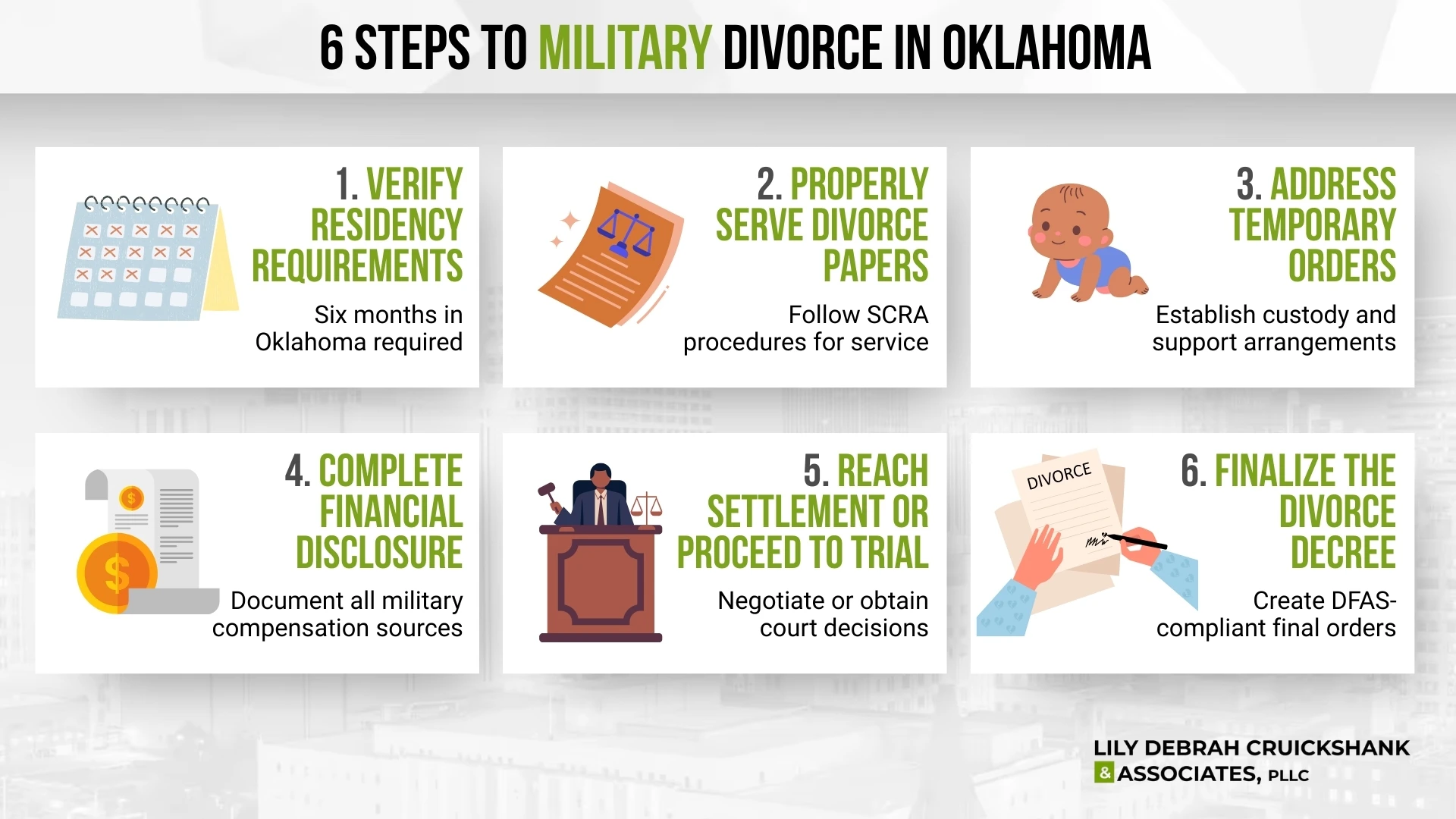
The military divorce process in Oklahoma follows specific steps accounting for federal protections and state requirements. Understanding this process helps service members and spouses prepare for what lies ahead, from initial filing through final decree. Each step involves unique considerations that don't exist in civilian divorces.
Step 1: Verify Residency Requirements
Oklahoma requires at least one spouse to have lived in the state or on a U.S. military installation in Oklahoma for 6 months before filing. Service members stationed in Oklahoma meet this requirement regardless of legal domicile.
Step 2: Properly Serve Divorce Papers
Serving divorce papers on active duty members requires strict procedures. For deployed personnel, service may go through their commanding officer. The Servicemembers Civil Relief Act mandates specific affidavits confirming military status.
Step 3: Address Temporary Orders
Courts establish temporary arrangements for child custody and child support while Oklahoma divorces proceed. These orders provide structure during uncertain times.
Step 4: Complete Financial Disclosure
Both parties must provide complete financial information, including military retired pay, housing and subsistence allowances, and Thrift Savings Plan contributions. Full disclosure ensures accurate property division and support calculations.
Step 5: Reach Settlement or Proceed to Trial
Military divorce matters often settle through negotiation. When settlement isn't possible, an Oklahoma judge makes binding decisions on contested issues.
Step 6: Finalize the Divorce Decree
The final decree must comply with Oklahoma law and federal requirements, and the orders must be structured to meet DFAS guidelines. The decree must include specific language for direct payment of retirement benefits.
Child Support and Spousal Support in Military Divorces
Oklahoma's child support guidelines and spousal support framework apply to military families with specific considerations for military compensation. Divorce and military benefits calculations differ from civilian cases because military members receive various forms of compensation beyond base pay. Understanding what counts as income for support purposes is critical for both service members and spouses.
Oklahoma considers all forms of military compensation:
- Base pay: Regular military salary.
- BAH: Housing allowance (continues only with custody or child support).
- BAS: Food allowance counted as income.
- Special and hazardous duty pay: Additional compensation for specific or dangerous assignments.
In spousal support cases, courts consider the length of the marriage, earning capacity, standard of living, and financial resources. DFAS can garnish military pay for court-ordered child support.
Custody Considerations for Deployed Service Members
Military parents face unique custody challenges due to deployment schedules and frequent relocations. Divorce in the military affects custody arrangements differently than civilian cases because of the service member's obligations to deploy or relocate on short notice. Some Pentagon data shows divorce rates around 7% for female service members compared to 2.5% for males, making custody arrangements particularly important.
Deployment doesn't terminate custody rights. Oklahoma law protects service members' parental rights by allowing temporary custody modifications that revert upon their return. Recent Oklahoma law changes allow military parents to appear via video conference from their duty station.
Other Military Benefits Affected by Divorce

Beyond retirement pay and healthcare, several other military benefits change status after divorce. Divorce in the military affects spouses' rights and benefits, depending on the length of the marriage and service overlap.
Commissary and Exchange Privileges
Commissary and exchange privileges continue for former spouses who qualify under the 20/20/20 rule. Former spouses meeting only the 20/20/15 rule do not have these privileges. These benefits provide significant savings on groceries and goods.
Survivor Benefit Plan Coverage
The Survivor Benefit Plan provides continued income if a military retiree dies. Courts can order service members to maintain former spouse coverage with proper decree documentation, ensuring ongoing financial protection.
Military Legal Assistance Limitations
Military legal assistance offices can only represent the service member. Non-military spouses need their own civilian attorney familiar with military family law to protect their military spouse rights in divorce.
Why Military Divorce Requires Dedicated Legal Counsel
Navigating military divorce in Oklahoma requires expertise in both federal regulations and state family law, particularly when addressing alimony, retirement benefits, and healthcare coverage.
A civilian attorney experienced in military divorce matters brings critical knowledge about:
- Federal and state law interaction: How the USFSPA and SCRA align with Oklahoma divorce law to avoid mistakes in retired pay divisions and service of process.
- DFAS compliance: Drafting court orders that DFAS will accept for direct payment to former spouses.
- Federal agency procedures: Navigating DFAS, TRICARE, and SBP requirements, forms, and timelines.
- Military benefit protection: Securing healthcare, retirement, and survivor benefits owed under federal law.
- Deployment considerations: Handling custody and SCRA protections tailored to active-duty demands.
For service members and military spouses in Oklahoma, working with a family lawyer in Oklahoma City who focuses on military divorces helps avoid mistakes while protecting financial security.
Moving Forward After Military Divorce
Federal protections balance service members' obligations with family law requirements, but decisions made during military divorce affect financial security for years to come.
Lily Debrah Cruickshank & Associates, a family law firm in OKC, serves uniformed services families throughout Oklahoma County with guidance on dividing military retired pay, securing healthcare benefits, and protecting parental rights. Contact us for a consultation regarding your military divorce.
Our downtown Oklahoma City team has 20 years of litigation experience in military family law matters. We help service members and military spouses protect their rights.
Federal and state laws create unique challenges in military divorces. Our attorneys serve families in Oklahoma City and beyond.
Recent Posts
.avif)

Our Reach: Serving Oklahoma City and Beyond
We proudly serve the Oklahoma City community from our downtown office.Our experienced legal team extends its reach to surrounding areas, providing comprehensive family law services to families throughout the region.
Find Clarity and Direction for Your Family's Legal Matters!
Are you facing a family law challenge? Our experienced attorneys provide strategic legal representation, protecting your rights and ensuring the best possible outcome. Schedule a consultation to discuss your situation and develop a plan.
- Address11317 S. Western Ave,
Suite 300, Oklahoma City, Oklahoma 73170 - Phone(405) 606-3062
- Fax(405) 606-3065
- OKLAHOMA OFFICE
- Review Us