

Legal Separation and Finances: What Happens to Your Money When You Split
Legal separation creates a middle ground between staying married and getting a divorce, but many people wonder whether it actually shields their bank accounts, credit scores, and future earnings. The reality is more nuanced than a simple yes-or-no.
If you're considering this option, separation guidance in Oklahoma City can help you create agreements that truly safeguard your finances. This post walks through what legal separation means for your money, your debts, and your financial future.
What Is Legal Separation in Oklahoma?

Legal separation is a court-approved arrangement that allows married couples to live apart while remaining legally married. Under Oklahoma Statute Title 43 § 43-130, courts can grant legal separation based on the same grounds used for divorce, and the court can address property division, custody, support, and other matters just as it would in a divorce proceeding.
The key difference from divorce is that your marital status remains intact, meaning you cannot remarry, and certain benefits tied to marriage remain available. This arrangement requires either a formal separation agreement between spouses or a court order that establishes the terms of your separation, including how you'll handle financial matters going forward.
What Legal Separation Actually Does for Your Finances
Legal separation allows you to formalize the end of your marital partnership without filing for divorce. This legal process involves creating a separation agreement or obtaining court orders that outline how you'll divide assets and handle debts while remaining legally married. The financial implications can be significant when done properly.
Establishes Financial Independence Between Spouses

A formal legal separation agreement draws clear lines between what belongs to you and what belongs to your spouse going forward. After the separation date specified in your agreement, income you earn typically becomes your separate property rather than continuing to add to the pool of shared assets.
Key protections include:
- Future earnings: Raises, bonuses, and other income after separation remain yours alone, as in property division in divorce.
- New purchases: Items bought with your separate income after separation typically belong only to you.
- Credit boundaries: New debts incurred by one spouse after separation don't automatically become the other spouse's responsibility when properly structured.
Important note: Without a signed separation agreement or court order, you remain financially entangled regardless of where you're living.
Divides Existing Assets and Debts Clearly
One of the most valuable aspects of legal separation is the formal division of what you've accumulated during your marriage. Through either negotiation or family court proceedings, you and your spouse determine who gets which assets and who pays which debts.
The separation process addresses:
- Marital property: Real estate, vehicles, and bank accounts get assigned to one spouse or the other.
- Business interests: Any business ownership requires valuation and division specifications.
- Joint accounts: Credit cards and loans need a clear designation of who pays what.
- Retirement accounts: 401(k)s and pensions can be addressed in a separation agreement, but plan administrators typically require a divorce decree and QDRO to divide them. You can agree on future division during separation, but actual division usually occurs at divorce.
Property deeds and account titles may need formal changes to reflect your new arrangement.
Financial Benefits That Legal Separation Offers
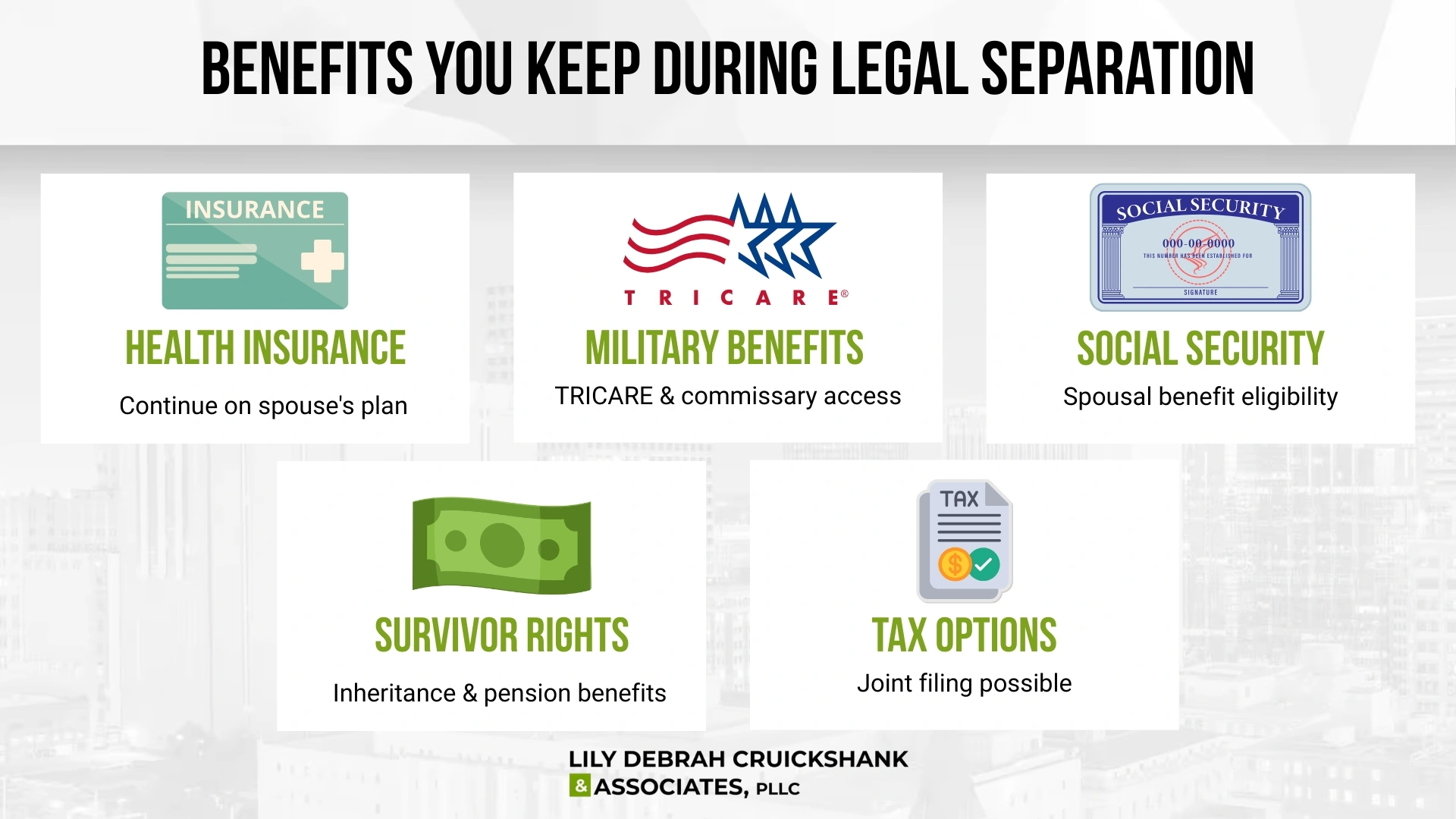
Choosing legal separation over divorce can preserve certain financial advantages while still providing the independence you need. These benefits make legal separation particularly attractive for couples who have religious objections to divorce or who simply aren't ready to make that final step.
Maintains Access to Valuable Marital Benefits
Staying legally married while separated allows you to keep accessing benefits that would end with a divorce decree. This can translate into substantial financial security, particularly when one spouse depends on the other's employer benefits.
Benefits you can maintain:
- Health insurance: Continue on your spouse's plan since you're still legally married, avoiding the costs of separate coverage.
- Military benefits: Spouses may retain commissary privileges and TRICARE coverage.
- Social Security: Claim spousal benefits based on your spouse's earnings if your marriage lasted ten years.
- Survivor benefits: Maintain inheritance rights and may receive pension benefits or life insurance proceeds. However, actual division of pension accounts typically requires divorce finalization.
These protections make legal separation particularly valuable compared to immediate divorce proceedings.
Provides Potential Tax Advantages
The tax benefits of legal separation depend on your specific situation. Depending on when you legally separate, you may be able to file jointly for that tax year, potentially lowering your tax burden.
Your separation agreement can specify which parent claims children as dependents for strategic tax planning. For agreements established before certain tax law changes, spousal support payments may be tax-deductible for the paying spouse.
The Protection You Need: A Formal Separation Agreement

Verbal agreements between you and your spouse won't protect your finances. The real question isn't just "does a legal separation also separate finances," but whether you have the legal documentation to make that separation enforceable. Without proper paperwork, you're leaving yourself vulnerable.
What Happens Without a Written Agreement
Living in separate households without a legal separation agreement creates a dangerous gray area. You're still married in the eyes of the law, which means you face significant financial risks.
Risks of informal separation:
- Debt liability: Creditors can pursue you for debts your spouse incurs on joint accounts.
- Asset disputes: Property acquired during separation may be subject to division later.
- Credit damage: Your credit score suffers if your spouse stops paying joint bills.
- No enforcement: Courts won't uphold verbal promises about finances.
These issues make proper documentation as critical as having a prenuptial agreement before marriage.
Essential Elements of a Strong Separation Agreement
A properly drafted separation agreement functions as a legally binding contract between you and your spouse. Under Oklahoma Statute Title 43 § 43-134, separation agreements can be incorporated into court orders, making them enforceable.
Working with a family law attorney ensures you don't overlook provisions like asset division details, debt assignment, spousal support terms, and custody arrangements if you have minor children.
Debt Responsibility During and After Legal Separation
One of the biggest worries people have when separating is whether they'll be stuck paying for their spouse's spending. The answer depends on when the debt was incurred, what type it is, and what your separation agreement says about financial responsibility.
How Debts Get Divided in Legal Separation
Oklahoma follows equitable distribution principles under Title 43 § 43-121 for marital debts, meaning courts aim for fairness rather than a strict 50-50 split. Your separation agreement should address both existing debts and establish rules for new debts.
Joint credit cards require special attention since you're both legally liable to the creditor regardless of what your agreement says. The spouse keeping property like the marital home typically takes responsibility for the associated loan, while student loans from before marriage usually remain the individual's responsibility.
Protecting Yourself from New Debts
Once your legal separation is official, your separation agreement should explicitly state that debts incurred by one spouse after the separation date are that spouse's sole responsibility. However, creditors aren't bound by your private agreement.
Steps to protect yourself:
- Close joint accounts: Contact credit card companies and lenders to close or separate joint accounts.
- Open separate accounts: Establish a checking and a savings account in your name only.
- Monitor your credit: Check your credit report regularly for unauthorized accounts.
Reality about joint debts: Even with a separation agreement, creditors can pursue you if your name remains on the account.
Financial Obligations You Can't Escape

Legal separation doesn't eliminate certain financial responsibilities, particularly when children are involved. Courts prioritize the best interests of minor children above the financial convenience of parents, so you'll need to maintain specific obligations regardless of your marital status.
Child-Related Financial Duties
Parents remain financially responsible for their children whether married, separated, or divorced. Under Oklahoma Statute Title 43 § 43-118, courts establish child support based on state guidelines.
Your separation agreement must address regular support payments from the non-custodial parent, health insurance coverage for the children, and proportional sharing of childcare costs needed for work.
Spousal Support Considerations
Unlike child support, spousal support isn't automatic in legal separation. Courts grant support based on factors such as the length of the marriage, each spouse's earning capacity, and financial obligations.
Your separation agreement might include support for a specific period or until certain conditions are met. Amounts are determined by the requesting spouse's financial needs and the other spouse's ability to pay.
Important Considerations When Choosing Legal Separation
Legal separation offers benefits but also comes with limitations you should carefully consider. The right choice between legal separation and divorce depends on your specific financial situation, your future plans, and what matters most to you.
When Legal Separation Makes Financial Sense
Certain situations make legal separation the smart financial choice, at least temporarily. If one spouse depends on the other's health insurance and can't afford separate coverage, staying married while separated maintains that access.
When your marriage is approaching the ten-year mark needed for Social Security spousal benefits, waiting to divorce makes financial sense. Service members' spouses need 20 years of marriage overlapping with service to qualify for certain military benefits.
Limitations to Keep in Mind

Legal separation solves some problems, but creates others you need to consider. You can't marry someone else while legally separated since you're still married to your current spouse.
You remain legally tied to your spouse in ways that can complicate future financial decisions and estate planning. Additionally, retirement accounts typically cannot be formally divided until divorce is finalized, even if your separation agreement addresses how they should be divided.
If you later want a full divorce, you'll need additional legal processes, though having a separation agreement can simplify proceedings.
Steps to Take Right Now to Protect Your Finances
If you’re considering legal separation, acting early can protect your finances and credit. Unlike divorce, legal separation allows you to remain married, which means joint assets and debts can still affect you.
- Gather financial documents: Gather bank statements, tax returns, credit card records, retirement information, and property deeds. You can document retirement accounts during separation, but dividing them usually requires divorce.
- Open individual accounts: Set up a checking account in your name only, preferably at a separate bank. This helps protect income and separate financial decisions while you are legally separated.
- Freeze joint credit: Close or freeze joint credit accounts to prevent new debts that could impact your credit during the separation process.
- Update beneficiaries: Review insurance policies and retirement accounts to ensure designations match your wishes. You can change beneficiaries on accounts you solely own, but joint retirement accounts may have restrictions, and formal division typically requires divorce.
- Work with proper legal support: Verbal agreements and online forms often overlook financial matters, custody arrangements, and spousal maintenance. An experienced legal team can help ensure your formal agreement protects your interests.
Legal separation affects more than living arrangements. Taking prompt action and securing legal support can help protect your finances and provide stability as you move forward.
Taking the Next Step Toward Financial Security
Legal separation offers genuine financial protection when handled correctly through formal legal agreements. The key factors include having comprehensive documentation, properly dividing assets and debts, and knowing which benefits you maintain.
Our Oklahoma City family law firm creates separation agreements that provide real financial security while preserving valuable benefits. We handle the details that matter, from drafting enforceable terms to ensuring your separate property stays protected. Contact Lily Debrah Cruickshank & Associates for a free consultation.
Informal arrangements leave you financially exposed. Our Oklahoma City attorneys create separation agreements that shield your finances and secure your separate property.
Let our Oklahoma City team create a legal separation agreement that protects you from your spouse's debts and secures your separate property.
Recent Posts
Categories


Our Reach: Serving Oklahoma City and Beyond
We proudly serve the Oklahoma City community from our downtown office.Our experienced legal team extends its reach to surrounding areas, providing comprehensive family law services to families throughout the region.
Find Clarity and Direction for Your Family's Legal Matters!
Are you facing a family law challenge? Our experienced attorneys provide strategic legal representation, protecting your rights and ensuring the best possible outcome. Schedule a consultation to discuss your situation and develop a plan.
- Address11317 S. Western Ave,
Suite 300, Oklahoma City, OK 73170 - Phone(405) 606-3062
- Fax(405) 606-3065
- OKLAHOMA OFFICE
- Review Us